
McCain reports achieving global cage-free commitment while delaying Brazilian subsidiary's target until 2030; public campaign in São Paulo calls for consistency
Sinergia Animal launches a large-scale public projection questioning why McCain's global cage-free commitment does not yet apply to its Brazilian brand, Forno de Minas.
São Paulo, Brazil, July 1, 2026 — The façade of a building in downtown São Paulo became the backdrop for a large-scale public projection challenging McCain Foods' sustainability commitments. Organized by the international NGO Sinergia Animal, the intervention used World Cup-inspired visuals to ask a simple question: If McCain achieved its global cage-free commitment, why does Brazil have to wait until 2030?
The campaign refers to a public commitment made by Forno de Minas in 2018, when the company announced it would eliminate eggs sourced from caged hens by 2025. Earlier this year, that deadline was officially extended to 2030.
According to Sinergia Animal, the case extends far beyond animal welfare and raises broader questions about ESG credibility, corporate transparency, and the consistency of sustainability commitments across different markets.

Public Campaign on the Street for McCain Organized by Sinergia Animal
"Sustainability must be consistent. When a company presents a commitment as part of its global strategy, consumers and investors expect the same level of commitment in every market where it operates," said Cristina Diniz, Executive Director of Sinergia Animal Brazil.
The issue has gained particular relevance because McCain states in its latest Sustainability Report that it has achieved 100% cage-free egg sourcing across its global operations by 2025. However, the same report confirms that Forno de Minas will follow a separate implementation timeline, extending its transition until 2030.
The projection transformed the building into a visual narrative inspired by football culture, featuring red cards, cheering crowds, a goal celebration and images of caged hens. Throughout the evening, activists distributed educational materials, engaged with the public, and invited passersby to support the campaign through its online platform. The demonstration also reflects growing international scrutiny of corporate ESG commitments.
According to the Open Wing Alliance, 92% of corporate cage-free commitments due by 2024 have already been fulfilled worldwide, while 90% of commitments across Latin America were implemented on schedule. The findings indicate that cage-free sourcing has become an established industry practice among companies that have publicly committed to the transition.
For Sinergia Animal, the campaign aims to expand an increasingly important discussion among consumers, investors, and sustainability professionals.
"The question is not only when a company will meet a commitment. It is whether public commitments retain the same value regardless of the country where they are implemented," Diniz added.
Why this matters
The debate is particularly significant because of McCain's global footprint. McCain Foods is one of the world's largest frozen food manufacturers, operating in more than 160 countries, with 49 production facilities across 15 countries, approximately 22,000 employees, and a network of around 4,400 farming partners.
Its Sustainability Report presents sustainability as one of the company's core business priorities, alongside regenerative agriculture, carbon reduction, renewable energy, and community development. Among the report's headline achievements is the completion of McCain's global commitment to source 100% cage-free eggs by 2025.
For Sinergia Animal, however, the same report also highlights a significant inconsistency: while the global target has been achieved, the Brazilian subsidiary will operate under a separate timeline until 2030.
The organization argues that this distinction raises broader questions about the consistency of corporate sustainability commitments across different markets.
The discussion comes at a time when companies worldwide face increasing scrutiny over the implementation—not merely the announcement—of ESG commitments. Climate goals, biodiversity targets, human rights policies, and animal welfare commitments are increasingly assessed by measurable outcomes rather than corporate messaging alone.
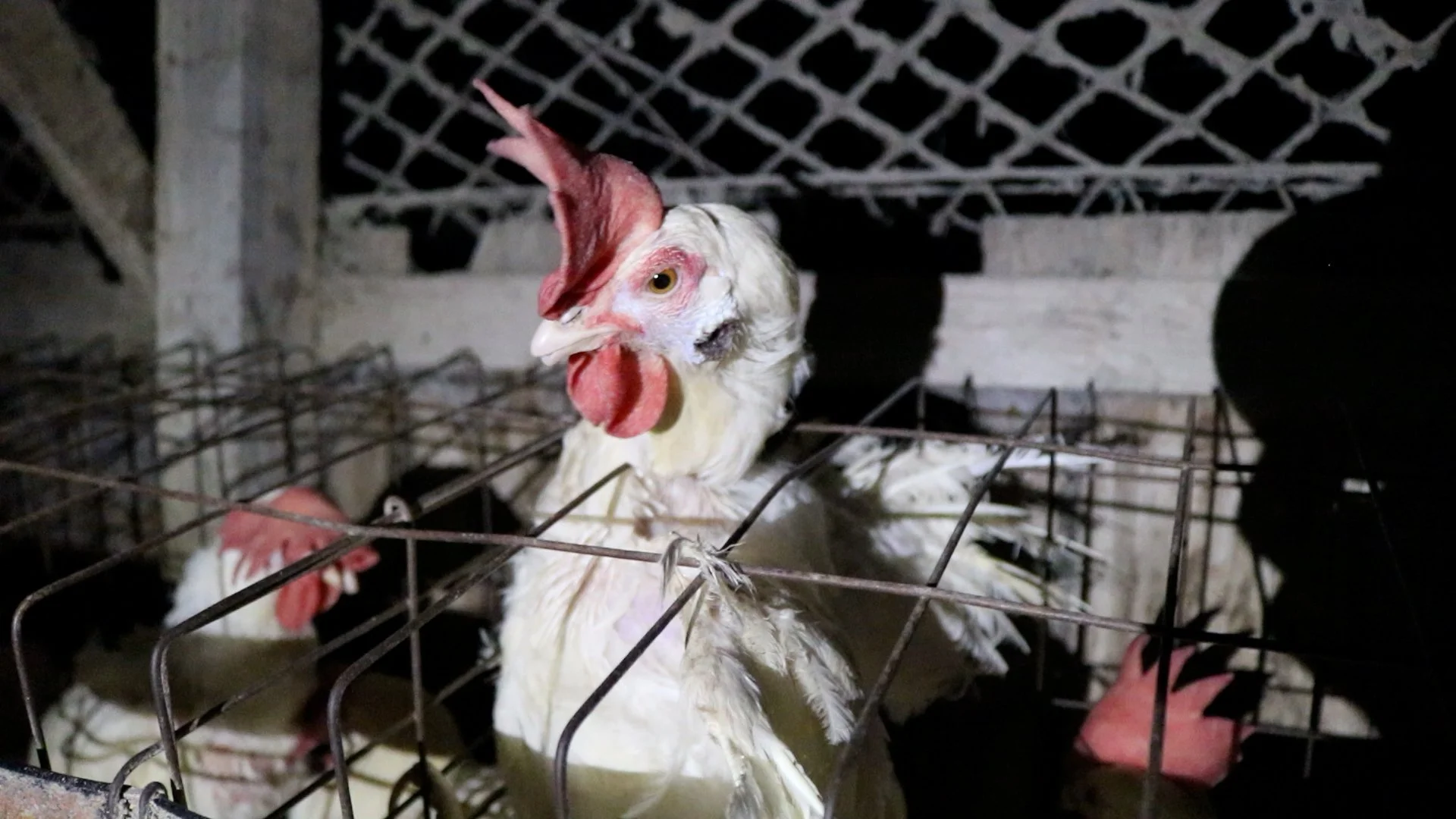
Egg Production in Battery Cage System in Brazil
According to Sinergia Animal, the central issue is not simply the extension of a deadline, but the precedent it sets. As ESG commitments become increasingly important indicators of corporate performance, maintaining different implementation timelines across markets raises legitimate questions about consistency, accountability, and stakeholder trust.
By bringing this discussion into public space through a large-scale urban projection, Sinergia Animal hopes to encourage a broader conversation that extends well beyond the Forno de Minas case.
The campaign asks a fundamental question: Can sustainability commitments truly be considered global if they are implemented at different speeds depending on the country?
For the organization, corporate credibility depends not only on setting ambitious goals but on applying those commitments consistently across every market where a company operates.